An injured triathlete is still a triathlete. With swim, bike and run, you can almost always train at least one discipline while something else heals. The week still has a job; the block still points at race day. That forced focus can be a chance to improve in the discipline that stays on the plan.
Single-sport athletes often face an empty calendar. Triathlon usually means shift — protect what hurts, train what you can, then ease back the injured discipline with graded volume and conservative session types. That only works if the plan adapts instead of leaving you to guess load on bike-only weeks or comeback runs.
On a WattX Race Plan PRO, that adaptation is built in. Season phases, recovery weeks, and taper live in race planning.
Why triathlon helps
Why Structure Still Matters
A calf strain or sore Achilles often means run waits — not a lost season. Bike and swim can keep their place in the macrocycle: real sessions, real targets, progressive weeks.
The risk without structure is predictable: too much on the sports still training, or too fast on the one returning. A good week redistributes some freed load to bike or swim, respects ceilings on how much each sport can absorb, and saves the injured discipline for a defined ease-back block — lighter at first, stepping toward full planned load.
That is the coaching model: pause what hurts, train what you can, start the return once you’ve healed, then build back to full load.
Phases
Phases on Your Plan
The affected sport steps off the week.
Bike, swim, or both stay on — same phase and rhythm as the rest of your season. Block status: Run paused.
Healed mid-week: one easy session back.
Tue–Sun heal only: one easy session on the returning sport; load shifts to live sports. Monday heal skips straight to phase 3.
Graded ramp over several weeks.
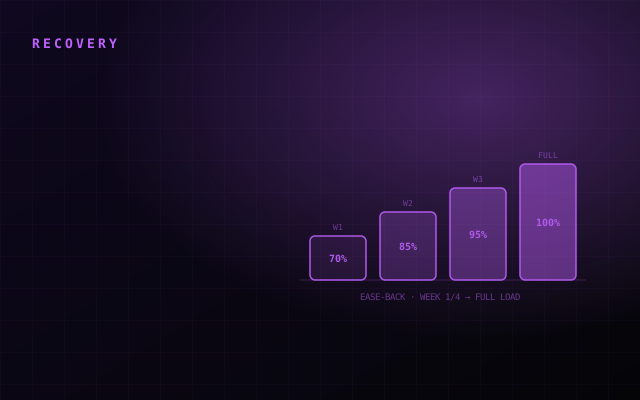
Softer session types and stepped volume — e.g. week 1 of 4 through week 4 of 4. Gap to full load shrinks each week; bike and swim settle back down.
Ease-back complete.
That sport is back in the macrocycle at normal planned volume. The plan shows full load restored for one week, then the injury line clears.
Only the disciplines you mark as affected change. Run out with a calf issue; bike threshold and swim endurance can stay as planned.
When you mark healed, the plan pivots from pause. Monday heal → phase 3 starts that plan week (Week 1/4). Tuesday through Sunday → phase 2 that week (one easy return session), then phase 3 from the following plan week. The first plan week after the ease-back block (e.g. week 5 if ease-back ran weeks 1–4) shows Full load restored. Disciplines that carried extra load while you were sidelined settle back as the returning sport ramps up — one continuous season, not a reset.
Redistribution
Train What You Can
When one sport pauses, most of that week’s intended load can move to the disciplines still training (within the ceilings below). During ease-back, a large share of the recovering sport’s gap — up to 85% — can shift the same way while run (or bike/swim) ramps back up.
Typical split of shifted load when a sport is fully off the week:
Run paused
Bike paused
Swim paused
Bike-only weeks are common. The goal is a trainable week that still respects race day.
Volume ceilings on live sports
Each discipline also has a maximum extra versus a normal week for that sport — applied after the split above:
| Sport | Two sports still training | Only sport still training |
|---|---|---|
| SWIM | up to +15% | up to +20% |
| BIKE | up to +35% | up to +50% |
| RUN | up to +10% | up to +15% |
Bike absorbs most shifted load in typical weeks (+35%, up to +50% when it is the only sport left). Swim and run caps are lower when another discipline is still training; each can take slightly more when it is the only sport left.
Volume % on the plan block
On the plan page block, volume % lines show injury impact only — not recovery-week dips, session rounding, or other macrocycle effects. The returning sport shows a deficit; live sports show gains only (a run injury will never show swim or bike below baseline because of that injury). Lines update when you select any week in the block chart.
Typical pattern during a run ease-back after ~2 weeks off (illustrative):
| Phase | Run | Bike / swim |
|---|---|---|
| Heal week (initiated) | Large deficit — one easy session | Gains — absorb freed run volume |
| Week 1/4 (~70% run) | ~−30% | Bike +, swim + (within caps) |
| Week 2/4 (~78% run) | ~−22% | Gains taper as run ramps |
| Week 3/4 (~85% run) | ~−15% | Smaller gains |
| Week 4/4 (~93% run) | ~−7% | Near baseline — lines may disappear |
The last ease-back week may overlap a scheduled macrocycle recovery week. The block pill can still show Week 4/4 while volume lines disappear once impact rounds to zero. The following week shows Full load restored.
Ease back
Ease Back to Full Load
The return is a block inside your season for that sport — stepped volume and softer session types until it is back at full planned load.
Ease-back length on WattX weighs time out, sports affected, volume before the break, and weeks left to race day — then caps the block so the return fits your training plan:
Starting load on the returning sport follows time off — a graded entry point for the ease-back block, not a single session target for the whole week:
| Time off (that sport) | Starting load |
|---|---|
| Up to 2 weeks | 70% |
| 3–4 weeks | 50% |
| 5–8 weeks | 30% |
| Longer | 20% |
Session types stay conservative on the returning sport first — see workout intensities for how recovery, endurance, and tempo differ from fartlek or VO₂ work. Until the ease-back is complete, that sport’s bricks and hard sessions are softened, not stripped.
Early ease-back weeks also use shorter sessions on the returning sport — smaller minimum durations and finer volume steps (e.g. 15-minute run floors in week 1–2) — before stepping up toward normal session length by the end of the block.
During ease-back, a large share of the recovering sport’s gap may shift to other disciplines — still within the same ceilings above. Each week the returning sport’s deficit shrinks and live-sport gains taper toward baseline.
On WattX
How It Shows on Your Plan
This flow is for sport-specific limitations in injury history — log the affected discipline and enable affects plan so your macrocycle adapts from that day forward. General time off from illness or travel belongs on the plan page as Absence, not here.
WattX rebuilds your training plan from today — respecting your limitation and transferring load toward the sports you can actually train.
Once you mark healed, the ease-back protocol kicks in: block length from time off, graded load on the returning sport, conservative session types, and week-by-week progress on your training plan.
Block status over time
Click any week in the block chart — the status line and volume % update for that week:
| When | Block status (example: run) |
|---|---|
| Sport paused | Run paused |
| Heal week (Tue–Sun) | Run Injury Healed · Building Back Protocol Initiated |
| Ease-back weeks | Run Injury · Building Back Protocol · Week 1/4 … through Week 4/4 |
| First week after ease-back | Run · Full load restored |
| Thereafter | No injury line — normal macrocycle |
Sport names link to injury history. Under the status line, volume % lines show injury impact only — returning sport deficit, live-sport gains. Not every discipline shows a line every week — only where load was actually shifted.
Plan adaptation from today.
Affected sports leave the feed; live sports keep sessions and targets on your plan page.
Redistribution, calculated.
Shifts toward live sports within the caps in this guide — strongest on bike in typical run-off weeks.
Back-to-training protocol.
Mark healed — ease-back length, load steps, and softer session types to full planned volume.
| Place | What you get |
|---|---|
| Injury Log | Onset, heal date, sports affected |
| Plan page → block area | Pause / Initiated / Building Back (Week X/Y) / Full load restored — plus injury-only volume % for the selected week |
| Session feed | Sessions for sports you can train; softer types on the sport easing back |
| Other sports | Same macrocycle rhythm as the rest of your season |
1 — WattX Race Plan PRO for your macrocycle. 2 — Injury Log when a sport must pause; tick affects plan. 3 — Plan Page for this week’s sessions, block status, and volume % lines. 4 — Session Generator for sports still clear, with zones from Threshold Testing. 5 — Mark healed when ready; the ease-back runs on the plan.
Season context
Tie-In to Your Season
Injury adaptation sits inside the same plan as recovery weeks, brick sessions, and race pacing on the sports still training.
After you heal, session hardness on the returning sport follows workout intensity — the plan favours endurance and tempo before top-end work and the full brick progression returns.